Mike Kelley's Where Art Meets Architecture 1 Download
What We Can Learn From the Exquisite History and Ornate Aesthetic of Gothic Architecture
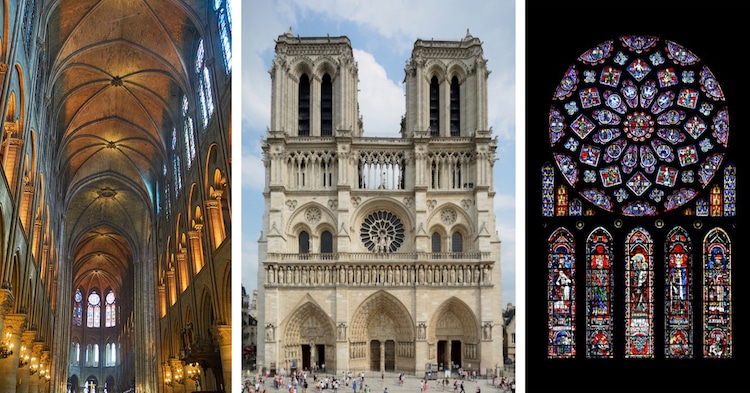
Aesthetically ornate and conceptually transcendent, the Gothic style has become one of the globe's most distinctive architectural movements. Though it originated in the Middle Ages, the one-of-a-kind genre continues to obsess today, as evident in some of Europe's most beautiful buildings.
While the Gothic arroyo appears to be a novel form of architecture, its signature style has been shaped by different influences. Here, we explore the genre, looking closely at its rich history, defining features, and nigh well-known examples.
What is Gothic Architecture?
Gothic architecture is a European mode of architecture that values height and exhibits an intricate and frail artful. Though its roots are French, the Gothic approach tin can exist found in churches, cathedrals, and other similar buildings in Europe and beyond.
History
During the Middle Ages, a new style of architecture emerged in Europe. Initially referred to equally Opus Francigenum , or "French Work," this architectural genre dominated European tastes—namely, that of the Roman Catholic Church—until the 16th century, when information technology became known equally "Gothic."
The Gothic style evolved from Romanesque compages, a medieval artful characterized by arches, vaulted ceilings, and small stained drinking glass windows.
Gothic architecture adopted and adjusted these Romanesque elements to produce a new style of building that featured exaggerated arches, increased vaulting, and enlarged windows. In addition to reinterpreting these characteristics, withal, Gothic architecture also abandoned one central feature of Romanesque architecture: thick walls. To construct taller, more delicate buildings with thinner walls, Gothic architects employed flying buttresses for support. These stone structures allowed architects to create sky-high cathedrals and churches that evoked ethereality and reached toward the heavens.
Archetype Elements
While the Gothic style can vary according to location, age, and blazon of building, it is often characterized past 5 cardinal architectural elements: large stained glass windows, pointed arches, rib vaults, flying buttresses, and ornate decoration.
Big Stained Glass Windows
While stained drinking glass windows are establish in many places of worship, they are particularly prevalent in Gothic cathedrals. Featuring meticulously cut colored glass, these kaleidoscopic windows—which are typically either tall and biconvex 'lancet' windows or round 'rose' windows—are larger than those found in other types of churches. This allowed them to let in more dazzling calorie-free.
Gothic stained glass windows too oftentimes feature tracery, a decorative type of stone support, and detailed scenes from Biblical stories.
Pointed Arches
A primary feature of many religious structures, ample archways can be found in most Gothic churches and cathedrals. Rather than the wide, rounded arches characteristic of Romanesque buildings, however, architects working in the Gothic style adapted the tall, thin pointed arches found in Islamic architecture.
This silhouette accentuated each cathedral'southward meridian, symbolically pointed toward the sky and accommodated similarly-shaped vaulting.
Rib Vaults
In order to incorporate higher ceilings and taller windows into their designs, Gothic architects utilized a new method of structural support called rib vaulting. Rib vaulting involves the utilize of intersecting barrel vaults—arches placed parallel to one another in social club to back up a rounded roof.
In addition to showcasing a more decorative aesthetic than traditional barrel vaults, these crisscrossed constructions offer increased support for the sky-high buildings.
Flying Buttresses
On pinnacle of these advanced vaulting techniques, Gothic architects employed another unique method of structural back up: flight buttresses. These projecting stone structures reinforced the buildings by redistributing the weight of the heavy roof to a lower, more solid level.
Flying buttresses ensured the cathedrals' integrity so that architects did not need to sacrifice the thin walls and large windows distinctive of the Gothic way.
Ornate Decoration
A final characteristic plant in Gothic architecture is the presence of ornate decorative elements. These include embellished colonnades and colonettes, sculptural moldings, statues of saints and historical figures, pinnacles and spires, and gargoyles, grotesque figures that double as water spouts.
Notable Buildings Built in the Gothic Way
Gothic buildings can be found in cities all over French republic and across Europe. Notable sites in France are Paris' Notre-Dame Cathedral, Chartres Cathedral, the Basilica of Saint-Denis, Amiens Cathedral, and Reims Cathedral.
Basilica of Saint-Denis
This medieval abbey church underwent a dramatic transformation that helped define Gothic architecture. Under the watchful eye of Abbot Suger, portions of the church building were rebuilt in the mid-12th century. This included the w façade, where the quondam building was demolished to make style for a new, innovative slice of architecture that used cut-edge techniques.
Vertical buttresses divided up the façade, while large window arches allowed for ornate sculptural decoration. This was a huge divergence from Romanesque façades and is the reason why Saint-Denis is known as the first Gothic building.
Notre-Dame de Paris
When most people think of Gothic architecture, Notre Dame is the first church that comes to mind. From its enormous rose windows to its flight buttresses and gargoyles, the cathedral exemplifies the Gothic style at its finest. Structure on the church building began in 1163 and its plans were influenced by the revolutionary new architecture seen in Saint-Denis.
It was more often than not completed past 1260 afterward flying buttresses were added to support the weight of the roof. Renovations and reconstruction have continued throughout the history of the church building, which is one of Paris' most visited sites. An unfortunate burn down in 2019 destroyed the spire and much of the roof. Reconstruction is ongoing with the building now having been secured. Officials accept promised that the building will exist fully restored in time for the 2024 Paris Olympics.
Chartres Cathedral
Due to the many fires that ravaged the building, Chartres Cathedral is an interesting mix of early and late Gothic. For instance, on the north façade, the right spire was created in a plainer, early Gothic mode that contrasts heavily with the left spire built in the 16th century. That spire was created in a Flamboyant style, complete with ornate bar tracery and extra sculpture. Chartres actually has iii façades which are filled with hundreds of sculptures that tell biblical narratives.
The Cathedral was spared both during the French Revolution and World War II thanks to the intervention of townspeople and an American colonel who pushed back confronting orders to destroy it.
Reims Cathedral
A beautiful example of the Loftier Gothic, the current iteration of Reims Cathedral was built when a fire destroyed the early Gothic structure. In its place went a church that took Gothic to its limits. The w façade has incredibly deep portals that allow for a complex sculptural program. This sculpture would have allowed illiterate churchgoers to visually see what they were unable to read. Above the central portal is a large rose window with thin tracery. The level above the rose window is reserved for the gallery of kings, which is made upwards of 56 statues that stand up 15 feet high. The interior has innovative four-part rib vaults that allow for a more uniform appearance while increasing the height.
While Reims Cathedral was largely spared during the French Revolution, it underwent extensive harm in Globe State of war I after occupying German troops used it to house their wounded soldiers. Costly renovations in the 20th century have restored it to its former glory.
Amiens Cathedral
Built over the course of just fifty years—a relatively short time in Gothic compages—the Amiens Cathedral is a wonderful example of the High Gothic. It represents the apex of trying to achieve for the heavens and stands as France's largest cathedral. To put things in perspective, two Notre-Dame Cathedrals could fit inside Amiens.
Construction began in 1220 subsequently a burn destroyed the earlier Romanesque cathedral. The church is particularly known for the quality of its sculpture on the primary façade.
Gothic Architecture in Europe
The Gothic style wasn't express to just France. This blazon of ornate architecture spread beyond Europe, finding a foothold in Italy, Germany, Spain, and England. Though each land gave the style its ain twist, international Gothic notwithstanding retains the basic elements constitute in France.
Milan Cathedral
The long history of the Milan Cathedral spans nearly 600 years, with construction beginning in 1386 and finishing in 1965. It'due south a wonderful instance of how Gothic architecture transformed outside of French republic. The edifice is most well-known for its façade, which has over 90 gargoyles, 135 spires, and well-nigh 3,400 sculptures.
Westminster Abbey
London's iconic Westminster Abbey took its current class under the eye of Henry III. He initiated construction in 1245 and had the abbey church built in an Anglo-French Gothic style. It includes all of the classic Gothic features, including flying buttresses, rib vaults, rose windows, and pointed arches.
The church, which has been the home to every English and British monarch since 1066 continues to play an important role in British civilisation.
St. Stephen'southward Cathedral
Located in Vienna, St. Stephen's Cathedral is a combination of Romanesque and Gothic styles. It features an impressive spire that dominates the skyline, just is most well-known for its colorful roof. Covered in 230,000 glazed tiles, the roof has a zig-zag design and a mosaic of a double-headed eagle. The cathedral also has 22 bells, 18 altars, and a massive stone pulpit that is a fine instance of Gothic sculpture.
Seville Cathedral
Spain'southSeville Cathedralis not only the largest Gothic church in the world, only the largest cathedral in the globe. Completed in the early on 16th century, it'southward known for its immense size, ornate tracery stonework, and the apply of a quondam mosque minaret every bit a bell tower.
Legacy
Equally both beautiful examples of age-former compages and as places of worship, many Gothic cathedrals remain popular destinations for tourists and pilgrims alike.
Additionally, given the spaciousness and captivating aesthetic of these buildings, many contemporary artists use Gothic cathedrals as the sites for their work, including projection art, multimedia installations, and interactive light shows.
This article has been edited and updated.
Related Articles:
Towering Photographs Highlight Stunning Intricacy of Gothic Architecture
16th Century Gothic Boxwood Miniatures With Extremely Detailed Carvings
Magnificent Art Nouveau Compages of the Great Antoni Gaudí
DOWNLOAD HERE
Posted by: rodriguezuposecushers.blogspot.com